
Accelerating Clinical Progress of Small Molecules & Biologics for Rare & Common Dermatological Conditions
With clinical progress evident from Sanofi, AbbVie, Pfizer, Sun Pharma, and BMS’s recent Phase III entries, 2026’s Dermatology Drug Development Europe Summit is evolving in line with industry - doubling down not only on late-stage data, regulatory pain points and patient access, but also on how stronger preclinical and translational strategies are enabling more confident progression into the clinic.
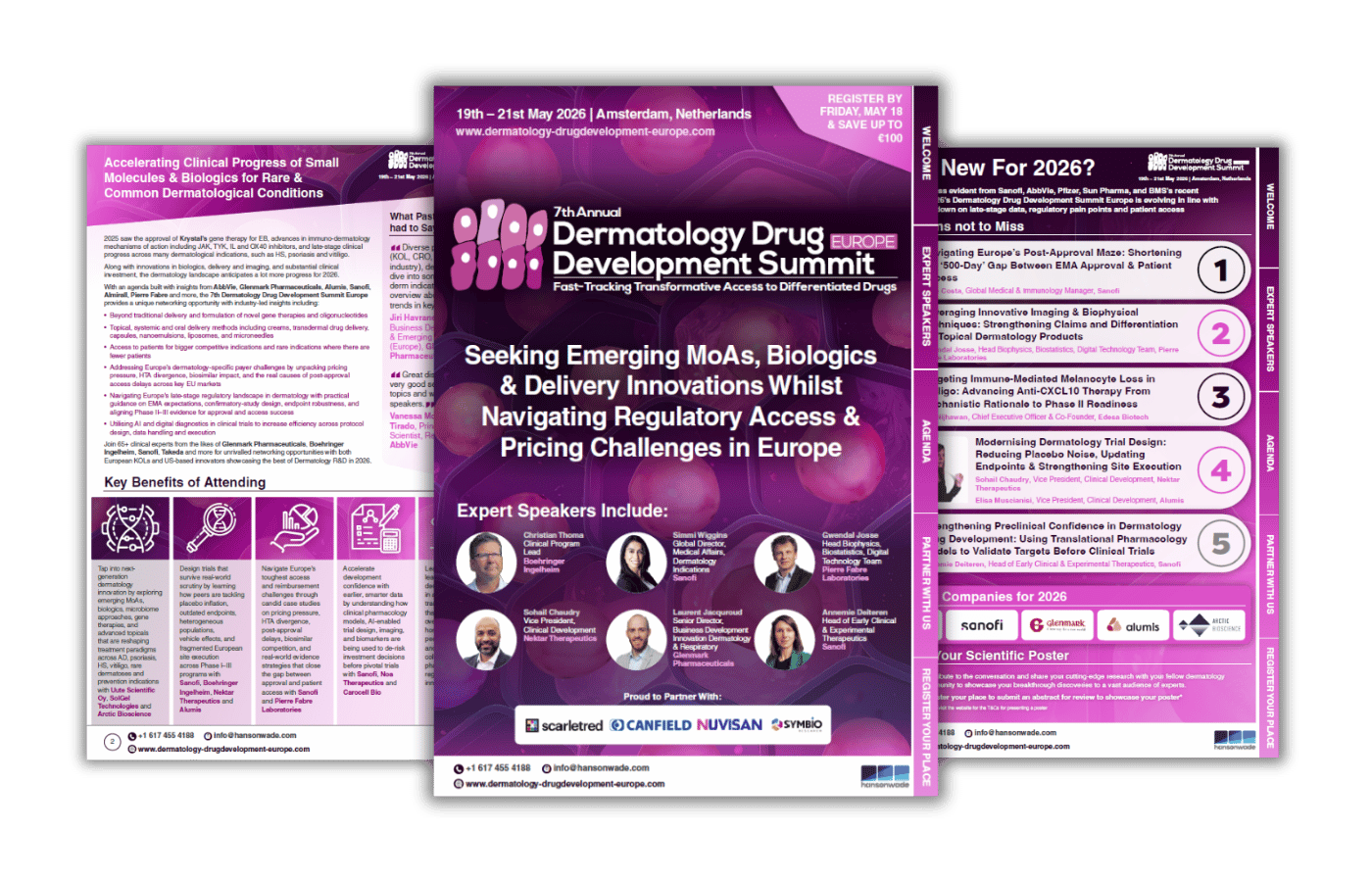
Across the Summit, delegates gained practical insight into how leading teams are boosting translation confidence through to real-world access. Sessions explored how to improve early proof-of-concept through predictive skin models, biomarkers and smarter study design, before unpacking how to shorten Europe’s post-approval “500-day gap” from EMA approval to patient access with Sanofi. Attendees tackled the uniquely high placebo burden in clinical trials with Inflarx N.V., and discover how advanced imaging and biophysical tools can strengthen differentiation claims with Pierre Fabre Laboratories. Further sessions will focus on modernising trial design, endpoints and site execution with Nektar Therapeutics and Alumis.
Together, these sessions provided a clear, end-to-end view of how dermatology programmes are being de-risked from preclinical stages, differentiated in development, and accelerated through to access in Europe today.
New presenting companies also included Boehringer Ingelheim,Glenmark Pharmaceuticals, Arctic Bioscience and more, uniting to ensure future dermatology therapeutics deliver meaningful impact for patients.
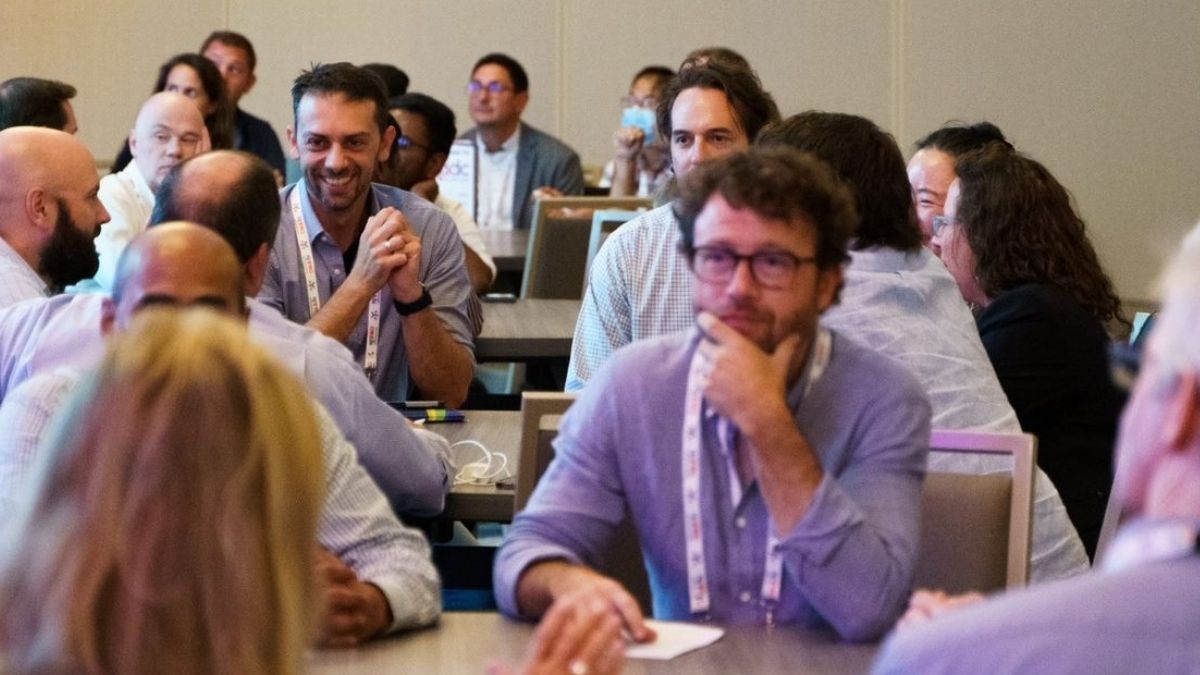
What You Missed In 2026: Unmissable Highlights of the 7th Dermatology Drug Development Summit Europe
Track the clinical inflection point in dermatology by examining how emerging and maturing mechanisms (IL, JAK, TYK2, OX40), alongside antibodies, gene therapies, oligonucleotides and advanced topicals, are moving decisively into Phase II–IV across AD, psoriasis, HS, vitiligo and rare dermatological disorders.
Redesign trials for a late-stage reality by learning how solution providers are adapting protocols to withstand high placebo and vehicle effects, evolving EMA expectations, heterogeneous patient populations, and fragmented European site execution, now critical as more assets advance toward pivotal and confirmatory studies.
Engage in deeper, more candid peer exchange within a single-track, industry-led forum built for a market now defined by late-stage pipelines, outsourcing-driven development models and global scrutiny, prioritising honest benchmarking, practical lessons and collaboration over volume or promotional noise.
Prepare for Europe’s tougher access environment in 2026 through real-world case studies addressing pricing pressure, HTA divergence, post-approval delays, biosimilar competition and payer evidence thresholds, reflecting the growing gap between regulatory approval and patient access.
Explore how leading teams are improving translational confidence through predictive skin models, precision biomarkers and smarter preclinical design to generate stronger proof-of-concept, overcome formulation and delivery challenges, and validate targets earlier in underserved indications such as HS, vitiligo and alopecia
Explore the Previous Event Guide
- Explore Disease Modifying Therapeutics with Boehringer Ingelheim and Merck
- Stay in the know with pipeline updates from SolGel Technologies, Arctic Bioscience and more
- Unveil top pharma speakers from the likes of Glenmark, Sanofi, Pierre Fabre, Nektar Therapeutics and more
- Navigate Europe’s post approval maze and strengthen preclinical confidence with Sanofi
Attending Companies Included

















Explore the Agenda to Discover the Clinical & Access Priorities Shaping Dermatology R&D in 2026
Explore a focused agenda late-stage case studies, interactive workshops and peer-led discussions tackling translational confidence, clinical design, regulatory access, reimbursement and differentiated dermatology modalities.
Partner to Position Your Solutions at the Centre of Active Dermatology Pipelines
Partner with the summit to showcase your capabilities to senior pharma and biotech teams actively seeking support across biomarkers, imaging, clinical trials, manufacturing and formulation.
Join Biopharma Experts to Connect with the Decision-Makers Driving Dermatology Development Forward
Join 65+ senior leaders from pharma and biotech for high-value networking, candid peer exchange and relationship-building across preclinical and late-stage development, access and launch in Europe.